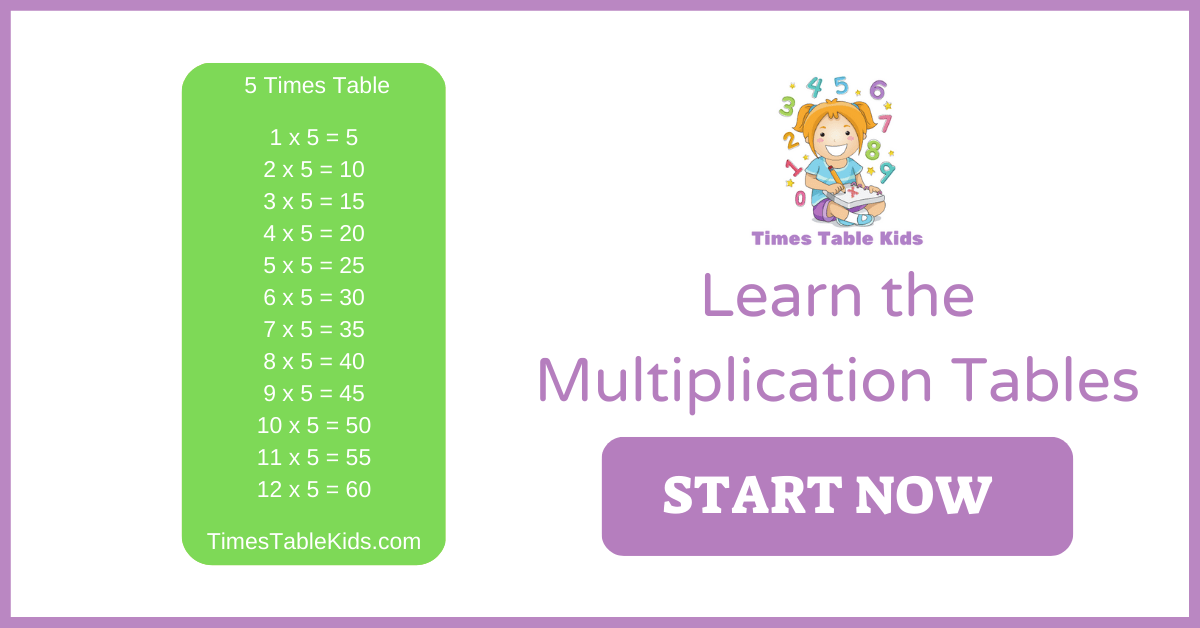
In multiples of 5 we count fives, that is, groups of 5.
For example, 7×5 equals 7 times 5.
Further down the page are study methods, exercises, games, and worksheets for learning the 5 Times Table.
Multiples of 5
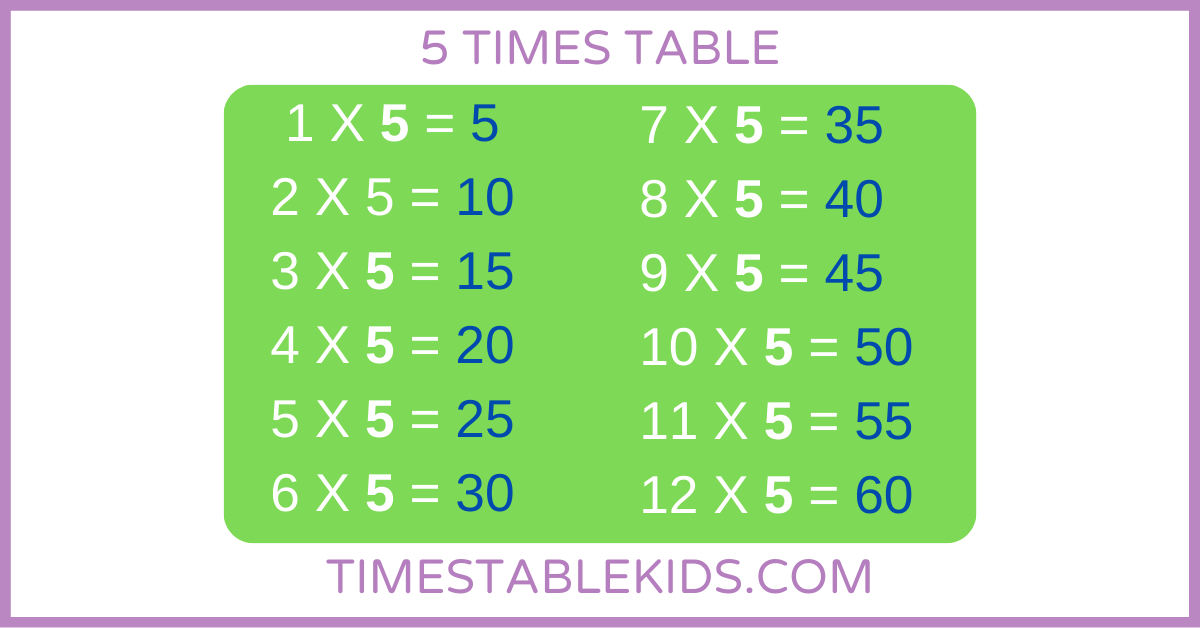
1 x 5 = 5
2 x 5 = 10
3 x 5 = 15
4 x 5 = 20
5 x 5 = 25
6 x 5 = 30
7 x 5 = 35
8 x 5 = 40
9 x 5 = 45
10 x 5 = 50
11 x 5 = 55
12 x 5 = 60
Practice 5 Times Table Quiz in Order
Solve the exercises. Then, click ‘Check’ to see how well you did!
If all the answers are correct, continue to practice the multiples in random order further down the page.
1 x 5 =
2 x 5 =
3 x 5 =
4 x 5 =
5 x 5 =
6 x 5 =
7 x 5 =
8 x 5 =
9 x 5 =
10 x 5 =
11 x 5 =
12 x 5 =
Practice 5 Times Table Quiz in Random Order
Solve the exercises. Then, click ‘Check’ to see how well you did!
If all the answers are correct, continue to the memory game further down the page.
5 Times Table Memory game
Try to find the matching questions and answers in as few attempts as possible!
5 Times Table puzzle game
Drag the correct answer to each question
5 Times Table Games
Choose a game to play
What is the 5 times table?
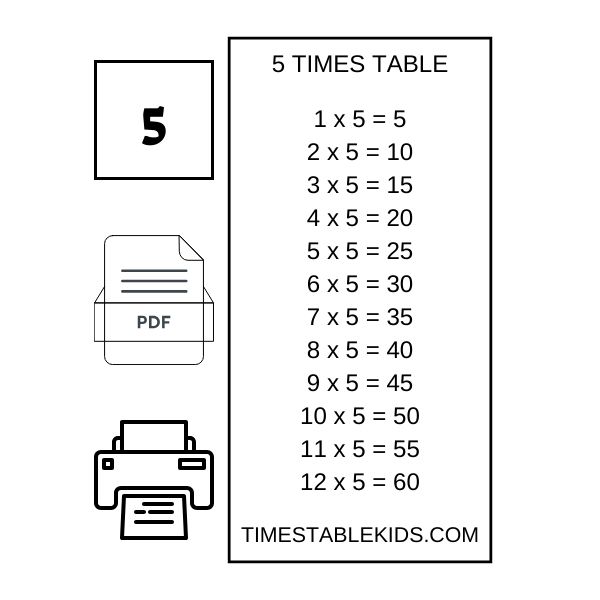
5 Times Table Chart Up to 12
Click on the image to download
How to learn and memorize the 5 Times Table?
In multiples of 5 we count fifths, that is, groups of 5.
For example, 7×5 equals 7 times 5
7×5 = 5+5+5+5+5+5+5 = 35
How do you easily calculate multiples of 5?
Multiples of 5 are easy to remember by heart. Remember the series of fives:
5, 10, 15, 20, 25, 30, 35, 40, 45, 50
When you want to calculate an exercise, raise the number of fingers as shown in the exercise and count the series, a number for each finger, until you reach the last raised finger. The number we arrived at is the answer.
For example, we will solve the 4×5 exercise. The number 4 appears in the exercise, so raise 4 fingers. Let’s count like this: 5 for the first finger, 10 for the second finger, 15 for the third finger, and 20 for the fourth finger. We reached 20 and this is the answer.
4 x 5 = 20
Interesting to know
Multiples of 5 are numbers whose unity digit is 0 or 5.
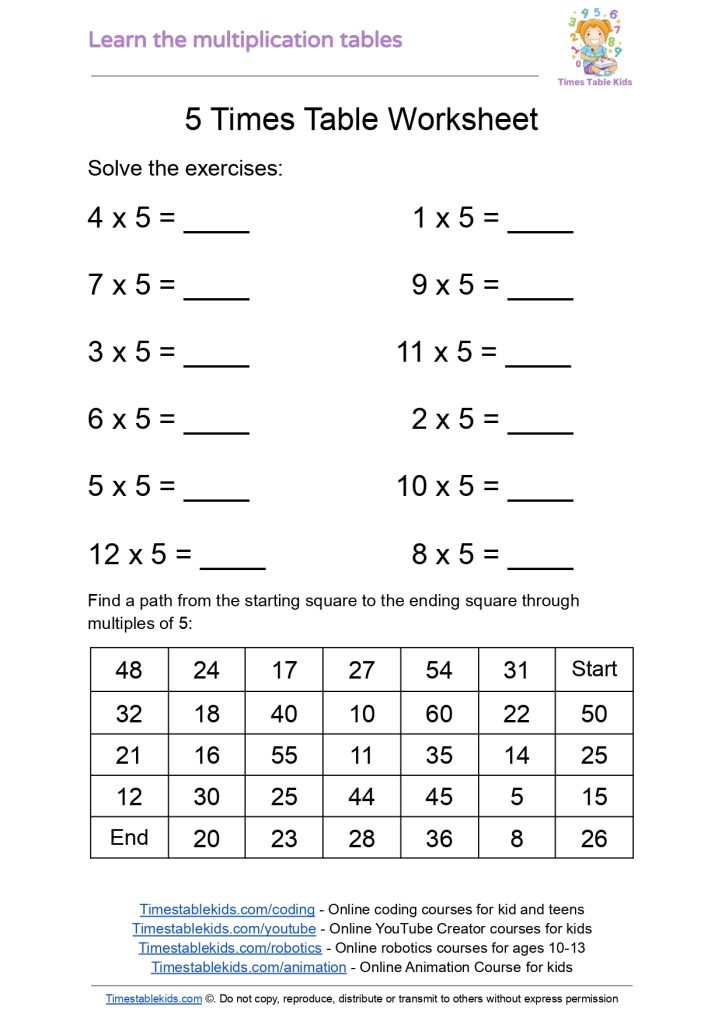
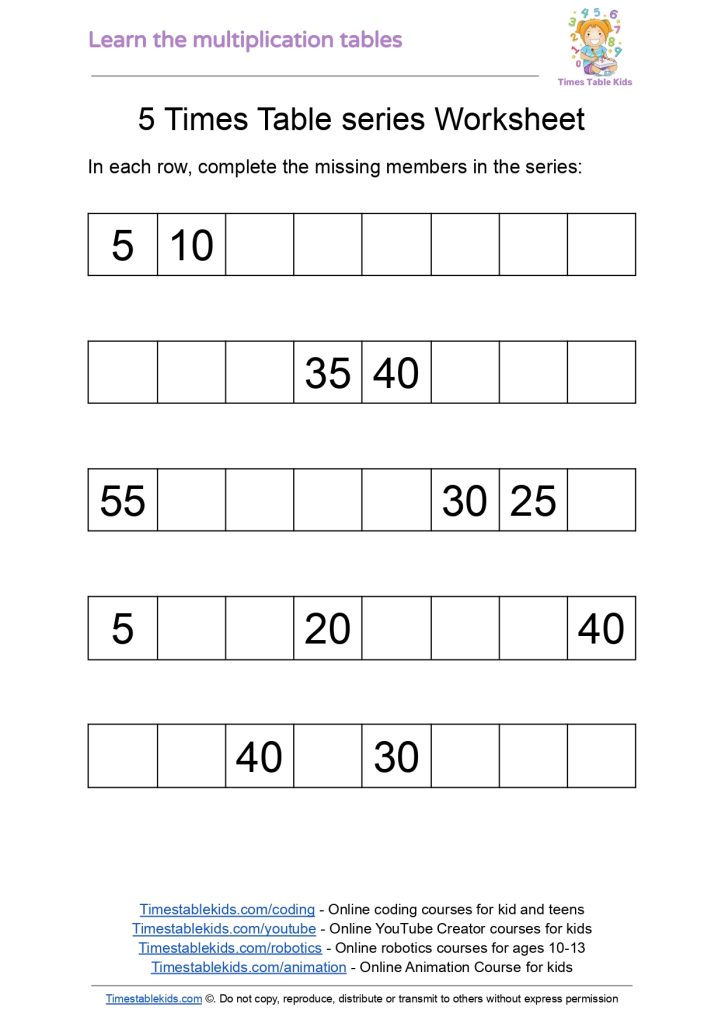
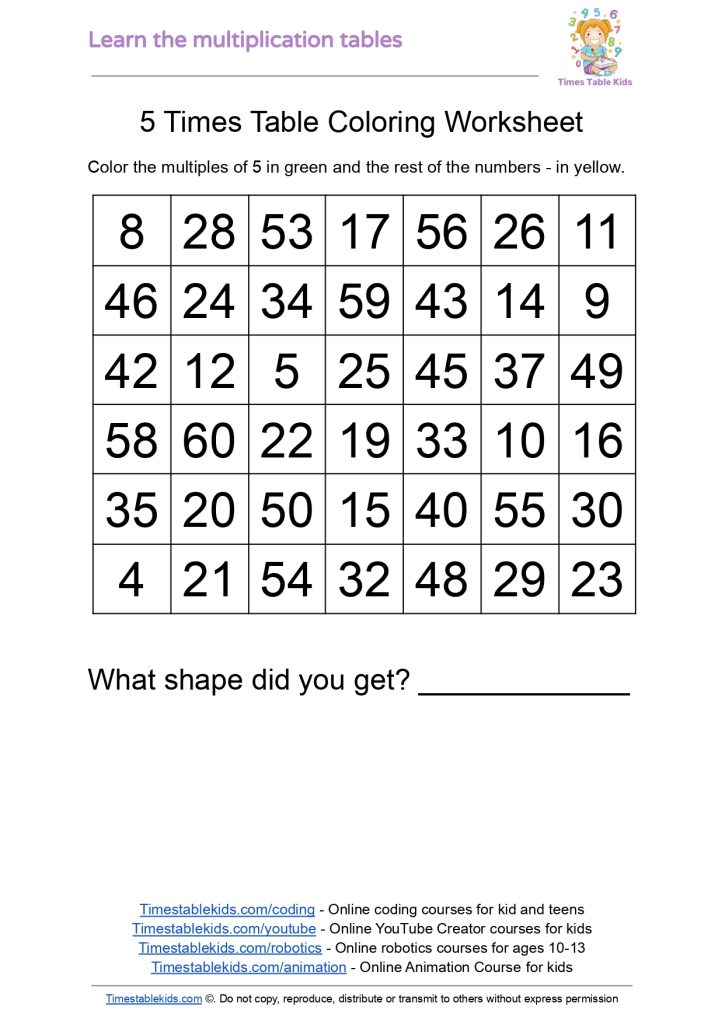
5 Times Table Worksheets
Click on the worksheets to download a printable PDF file
❓5 Times Table FAQ
The 5 times table is the list of multiples of 5: 5, 10, 15, 20, 25, 30, 35, 40, 45, 50, 55, 60. Every answer ends in either 0 or 5, making it one of the easiest times tables to learn.
The pattern is simple: every multiple of 5 ends in 0 or 5. When multiplying an even number by 5, the answer ends in 0 (e.g., 5 × 4 = 20). When multiplying an odd number by 5, the answer ends in 5 (e.g., 5 × 3 = 15). Another trick: multiply by 10 and halve it.
The multiples of 5 from 1 to 12 are: 5, 10, 15, 20, 25, 30, 35, 40, 45, 50, 55, and 60.
The multiples of 5 up to 100 are: 5, 10, 15, 20, 25, 30, 35, 40, 45, 50, 55, 60, 65, 70, 75, 80, 85, 90, 95, 100. That's 20 multiples in total. You can find a complete list and practise these facts using the exercises and games on this page.
The 5 times table is easy because of its predictable pattern — answers always end in 0 or 5. Children also recognise the pattern from telling time on an analogue clock, where each number represents 5 minutes.
Children usually learn the 5 times table in Year 2 (ages 6–7). Along with the 2 and 10 times tables, it's one of the first three tables most schools teach because of its clear, easy-to-spot pattern.
An analogue clock uses multiples of 5 for minutes: 1 o'clock = 5 minutes, 2 o'clock = 10 minutes, and so on. Practising the 5 times table helps children read the time, and reading the clock reinforces the 5s.
Yes. The Multiplication Tables Check tests all tables from 2 × 2 to 12 × 12. The 5 times table questions are included and are generally among the easier ones for most children.
Yes! This page has free interactive games, memory matching, puzzles, quizzes in order and random order, and printable worksheets — all dedicated to the 5 times table.