7 Times Table

In multiples of 7 we count sevens, that is, groups of 7.

For example, 6×7 equals 6 times 7.

Further down the page are study methods, exercises, games, and worksheets for learning the 7 Times Table.

multiples of 7

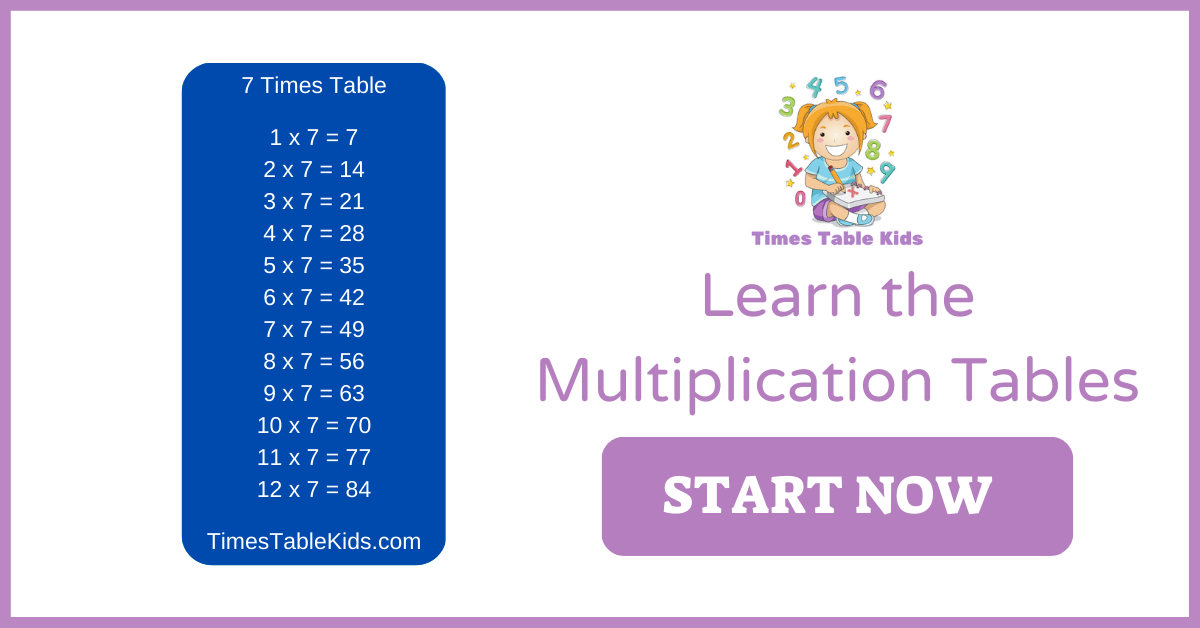
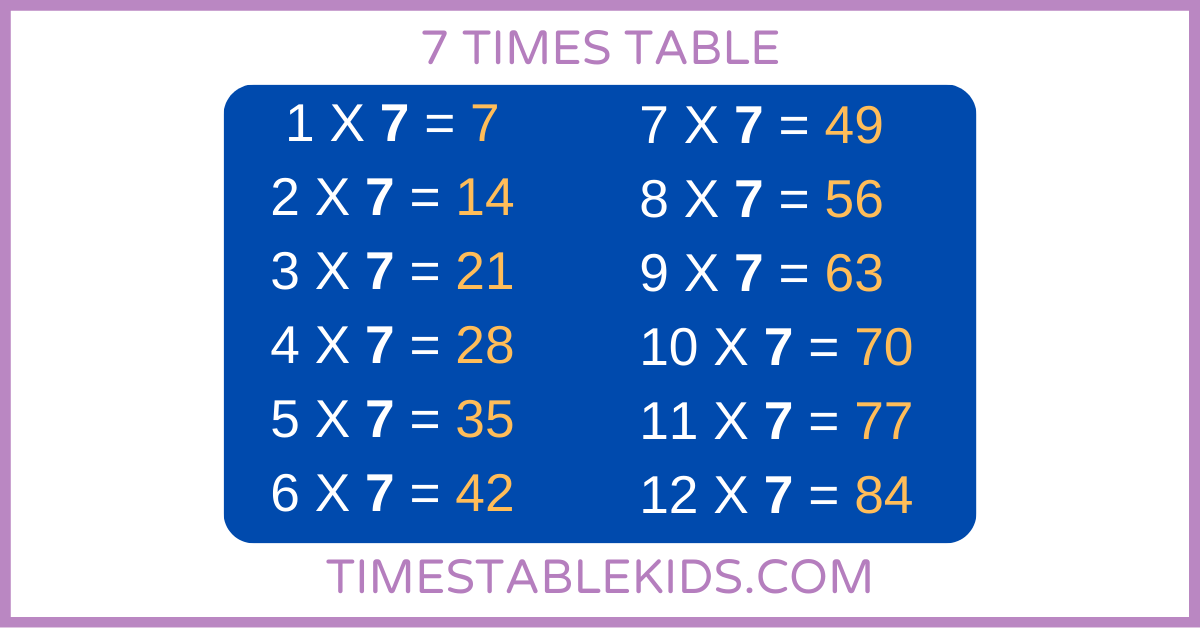
1 x 7 = 7
2 x 7 = 14
3 x 7 = 21
4 x 7 = 28
5 x 7 = 35
6 x 7 = 42
7 x 7 = 49
8 x 7 = 56
9 x 7 = 63
10 x 7 = 70
11 x 7 = 77
12 x 7 = 84

Practice 7 Times Table Quiz in Order

Solve the exercises. Then, click ‘Check’ to see how well you did!

If all the answers are correct, continue to practice the multiples in random order further down the page.

1 x 7 =
2 x 7 =
3 x 7 =
4 x 7 =
5 x 7 =
6 x 7 =
7 x 7 =
8 x 7 =
9 x 7 =
10 x 7 =
11 x 7 =
12 x 7 =

Practice 7 Times Table Quiz in Random Order

Solve the exercises. Then, click ‘Check’ to see how well you did!

If all the answers are correct, continue to the memory game further down the page.

7 Times Table Memory game

Try to find the matching questions and answers in as few attempts as possible!

7 Times Table puzzle game

Drag the correct answer to each question

7 Times Table Games

Choose a game to play

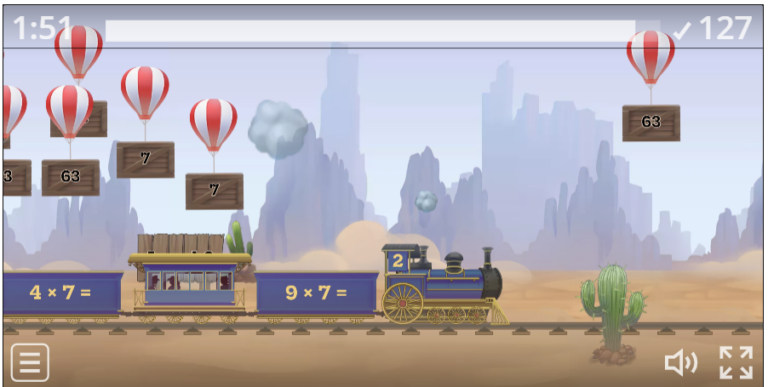
7 Times Table - 7 ka table - Pop Air Balloons
7 Times Table Quiz Game
7 Times Table - 7 ka table - Match Game
Match - 7 Times Table Game
7 Times Table - 7 ka table - Up in the Air
Air Plane - 7 Times Table Game
7 Times Table - 7 ka table - Win the Maze
Maze - 7 Times Table Game
7 Times Table - 7 ka table - Pop Air Balloons
Pop the Balloons - 7 Times Table Game

What is the 7 times table?

7 Times Table Chart Up to 12

Click on the image to download

How to learn and memorize the 7 Times Table?

In multiples of 7 we count sevens, that is, groups of 7.

For example, 6×7 equals 6 times 7

6×7 = 7+7+7+7+7+7 = 42

How do you easily calculate multiples of 7?

Method 1: To calculate an exercise involving multiplication by 7, you can calculate the same exercise, but with 5 instead of 7 and add the number that appears in the exercise twice.

for example,

3×7=(3×5)+3+3=15+6=21

Method 2: Multiples of 7 can be remembered in order. Start from the number 7 and add 7 each time. Get the series:

7, 14, 21, 28, 35, 42, 49, 56, 63, 70

When there is an exercise that involves multiplying by 7, raise your fingers according to the number that appears in the exercise and say the multiples in order, a multiple for each finger.

For example, to calculate 4×7, hold up 4 fingers and count as follows: 7 for the first finger, 14 for the second finger, 21 for the third finger, and 28 for the fourth finger. We reached 28 and this is the answer.

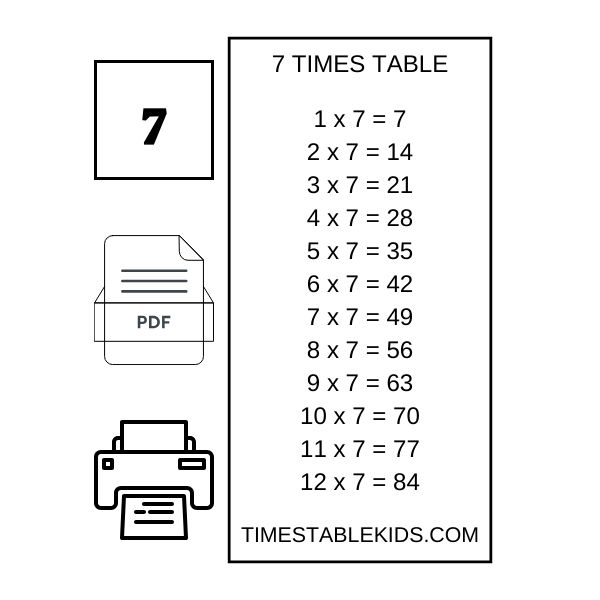
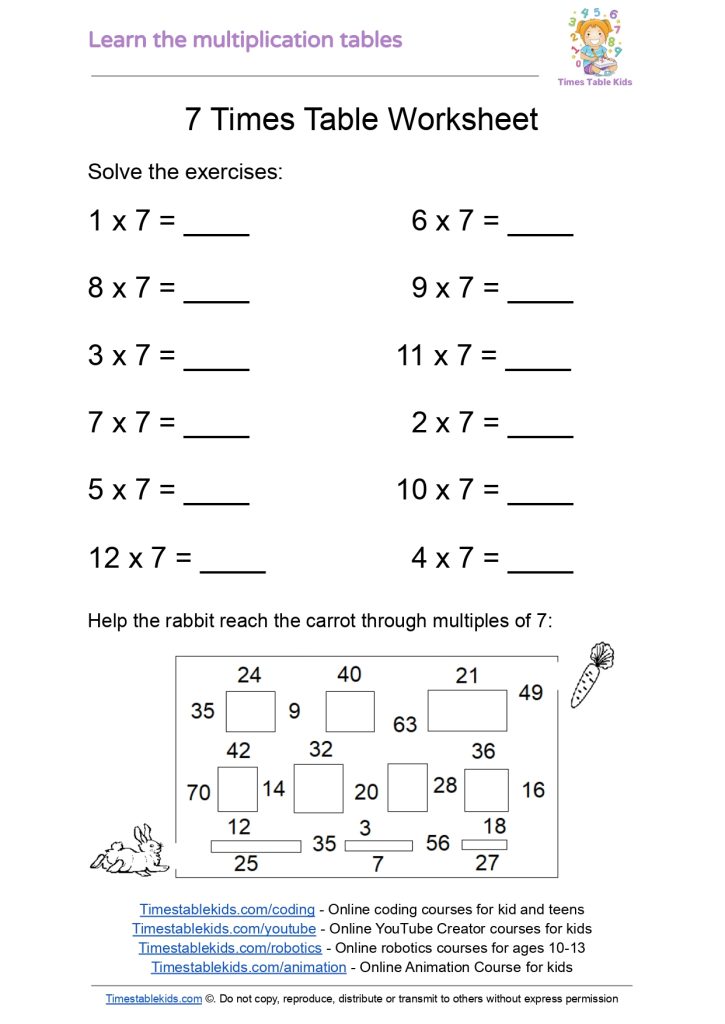
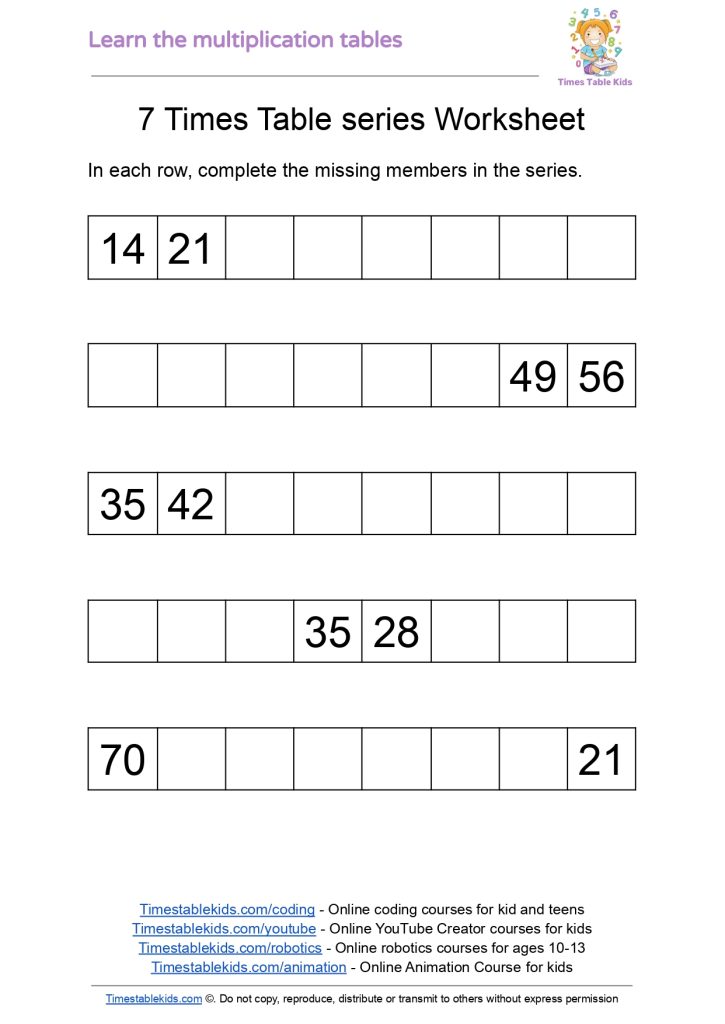
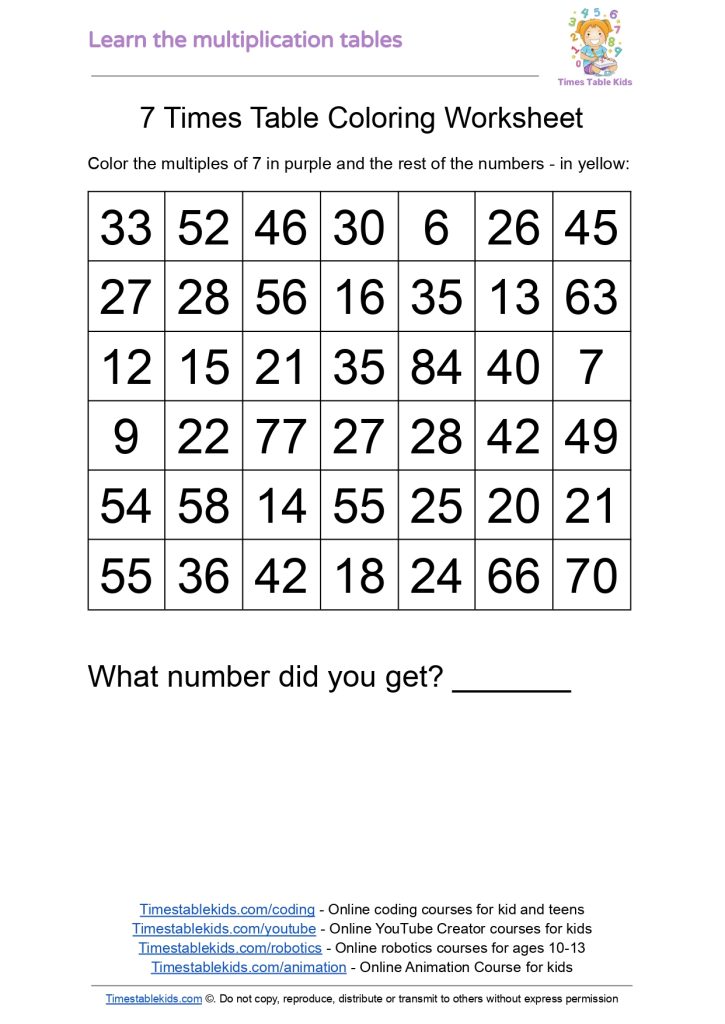
7 Times Table Worksheets

Click on the worksheets to download a printable PDF file

❓7 Times Table FAQ

The 7 times table is the list of multiples of 7: 7, 14, 21, 28, 35, 42, 49, 56, 63, 70, 77, 84. Multiplying by 7 means adding seven groups of a number.

The 7 times table is often considered the most difficult because there's no simple pattern in the last digits, unlike the 2s, 5s, or 10s. The facts that children find hardest — like 7 × 8 = 56 and 7 × 6 = 42 — tend to involve 7. Regular practice and using known facts from other tables can help.

The multiples of 7 from 1 to 12 are: 7, 14, 21, 28, 35, 42, 49, 56, 63, 70, 77, and 84.

The multiples of 7 up to 100 are: 7, 14, 21, 28, 35, 42, 49, 56, 63, 70, 77, 84, 91, 98. That's 14 multiples in total. You can find a complete list and practise these facts using the exercises and games on this page.

A few strategies can help: break it down (7 × 6 = 5 × 6 + 2 × 6 = 30 + 12 = 42), use known facts from other tables (if you know 3 × 7 from the 3s, you already know 7 × 3), and practise the tricky ones repeatedly — especially 7 × 6, 7 × 7, 7 × 8, and 7 × 9.

Children typically learn the 7 times table in Year 3 or Year 4 (ages 7–9). Because it's one of the harder tables, it often requires more practice time than the earlier ones.

7 × 8 = 56. It's one of the most commonly forgotten multiplication facts. A popular memory trick is '5, 6, 7, 8' — the answer 56 contains 5 and 6, and the question is 7 × 8. This sequence (5-6-7-8) makes it easy to remember.

Yes. The UK Multiplication Tables Check places extra emphasis on the harder tables, including the 7 times table. Questions involving 6, 7, 8, 9, and 12 appear more frequently in the test.

Yes! This page includes free quizzes, memory matching games, puzzles, and interactive activities — all focused on the 7 times table to help build fluency.

Continue studying the multiplication tables

Share the site with friends

Table of Contents

Picture of Yonit Riss

Yonit Riss

The content on this site was created by Yonit Riss, who holds a bachelor's degree in computer science and mathematics, a master's degree in mathematics, and a master's degree in linguistic editing — all from Ben Gurion University, Israel. She has 6 years of experience as an outstanding practitioner teaching undergraduate Calculus courses at the university. As a mother of two, Yonit is passionate about making multiplication tables fun and accessible for every child.