
The check is in June. The new Year 4 class is in front of you this week.
The statutory Multiplication Tables Check for 2026/27 is a two-week window beginning Monday 7 June 2027. Schools pick the day. There is no pass mark. It is 25 questions, six seconds each, on a school device, covering 2×2 up to 12×12. The 0 and 1 times tables are not in it. The Standards and Testing Agency weights 6, 7, 8, 9 and 12 more heavily than 2, 5 and 10, because those are the facts children still count up.
That is nine months away. A cold mock in week one does not help. What helps is knowing, in September, which tables this class already holds, and then spending ten minutes a week on the ones they do not.
If you want a first-week fluency slot that is not MTC-shaped, use the first-week classroom routine first, then come back here in week two or three.
What the check actually is
Not a SATs paper. Not a grade. A short on-screen recall check, administered by the school in the summer term of Year 4.
- 25 multiplication questions
- 6 seconds per question, then it moves on
- Answers typed on screen or with the on-screen number pad
- Tables from 2×2 to 12×12
- More items from 6, 7, 8, 9 and 12 than from 2, 5 and 10
- No official pass mark, and no result is published in league tables
The STA page with future dates is here: Primary assessments: future dates. The parent leaflet on GOV.UK is not tied to a school year — it just says the check happens in June, with no date. The format has not changed. So the leaflet plus the 7 June 2027 date above — which you add yourself — is what you send home.
September: one baseline, not a mock
In week two or three, once the class can sit still for six minutes, run the free simulator once.
MTC practice 2027 — 25 questions, six seconds, no account, works on the IWB, a tablet, or a laptop. There is a QR code you can put full-screen on the board, and one-click share to Google Classroom or Teams.
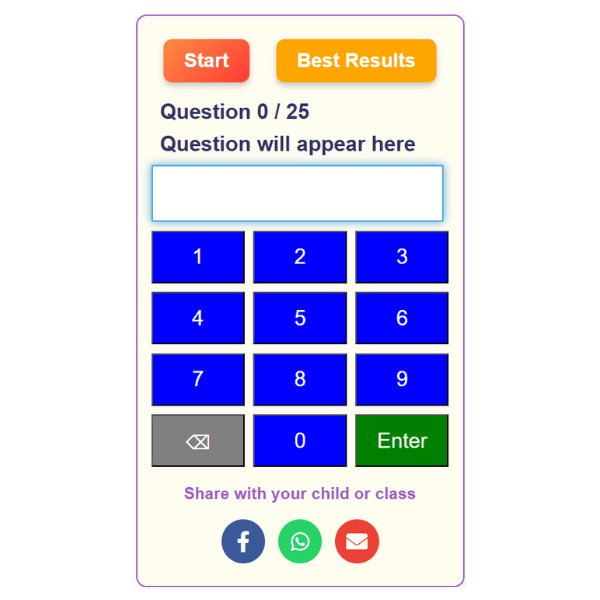
Do this:
- Say out loud that this is practice, that the real check is next June, and that a low score this month is information, not a verdict.
- Run it. Full screen if you can. Six minutes.
- After each attempt the tool lists the tables that child actually missed, and offers a worksheet or colour-by-number for those tables only. That list is your autumn groups.
- Do not enter the scores in a tracker yet. Keep the missed-tables list. That is the useful bit.
Children who freeze on the timer can do the same 25 facts untimed first, on a generated mixed sheet of 6, 7, 8, 9 and 12. Timed comes second, not first.
A score of 21 or more on our simulator prints a certificate. That threshold is ours, not STA’s. Do not treat it as a pass mark, and do not send it home as if it were official.
The tables that carry the check
If September grouping has to be simple, make it this:
| Already fluent | Teach next | MTC-weighted, start as soon as 3s and 4s hold |
|---|---|---|
| 2, 5, 10 | 3, 4, 11 | 6, 7, 8, 9, 12 |
The commutative facts cut the list in half. Once 6×7 is secure, 7×6 is not a new fact. Teach it that way on the board: one fact, two directions.
A ten-day classroom sequence that fits a 10-minute slot:
- Days 1–2: 6s (connect to 5s: 6×8 is 5×8 add one more 8)
- Days 3–4: 4s and 8s together (double the 4s)
- Days 5–6: 9s (the digits add to 9; 9×7 = 10×7 minus 7)
- Days 7–8: 7s, including 7×8 = 56
- Days 9–10: 12s (10× plus 2×), then a mixed 12-question sheet of all five
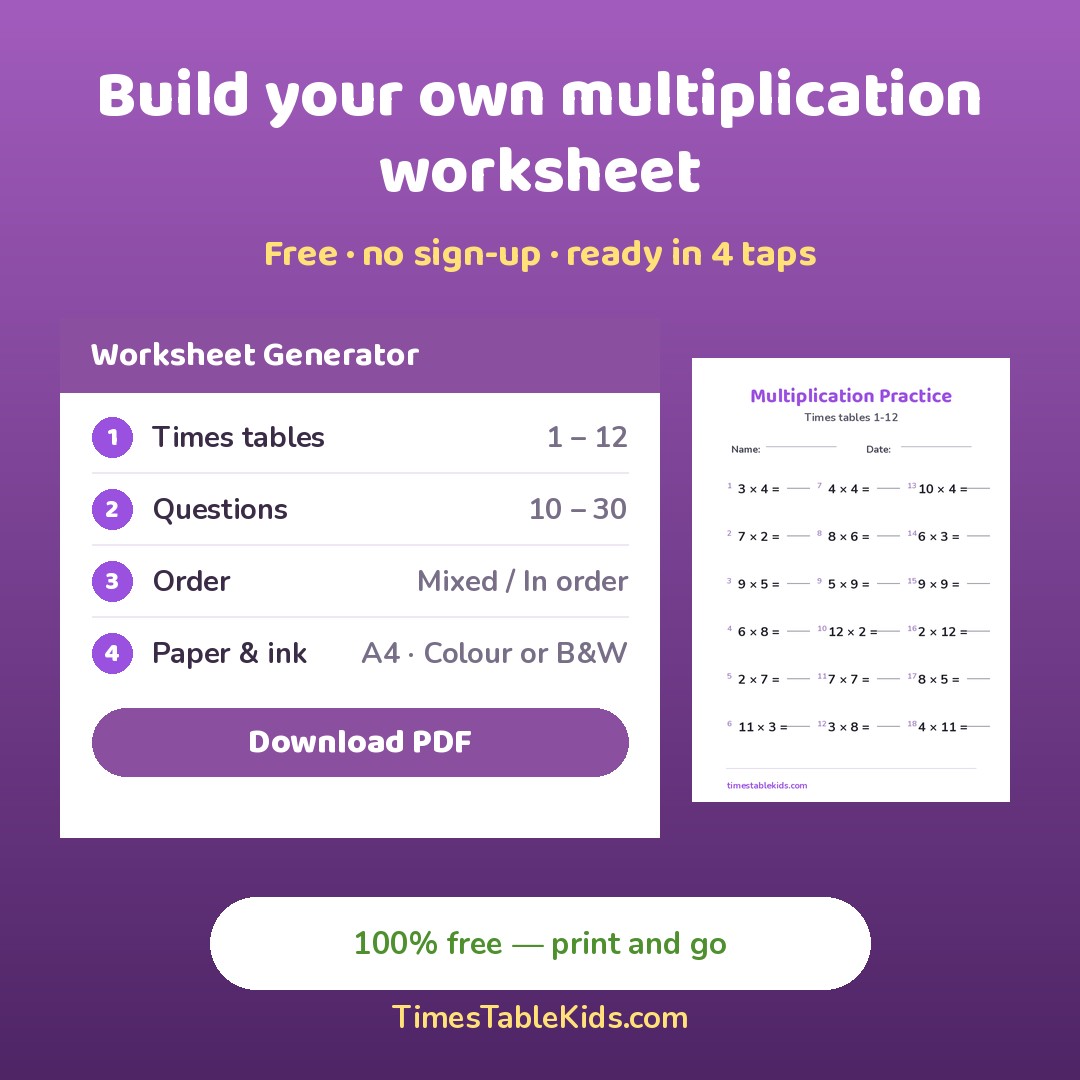
Use each table’s own page when you introduce it — 6, 7, 8, 9, 12 — then a generated mixed sheet, then one game on the board. The teacher hub has the embeddable quiz locked to the tables you tick.
A weekly plan that reaches Easter without panic
Ten minutes, same day each week, on top of whatever daily slot you already run.
September–October. Baseline. 3s and 4s until they hold. First pass at 6s. Half term is 26–30 October in a lot of English LAs; send home one colour-by-number, not a mock.
November–December. 6, 7, 8. One timed simulator in the last week of term, same rules as September: missed tables only, no tracker drama.
January–February. 9 and 12. Mixed sheets of the five weighted tables. Second simulator.
March–Easter. Mixed recall, including the easy tables so they do not go rusty. By now the simulator is familiar, so the six seconds feel like the tool, not a test.
Summer 1, then the window. From May, one short timed run a week. The check itself is the two weeks from 7 June 2027. Children who are away that fortnight usually sit it the week after.
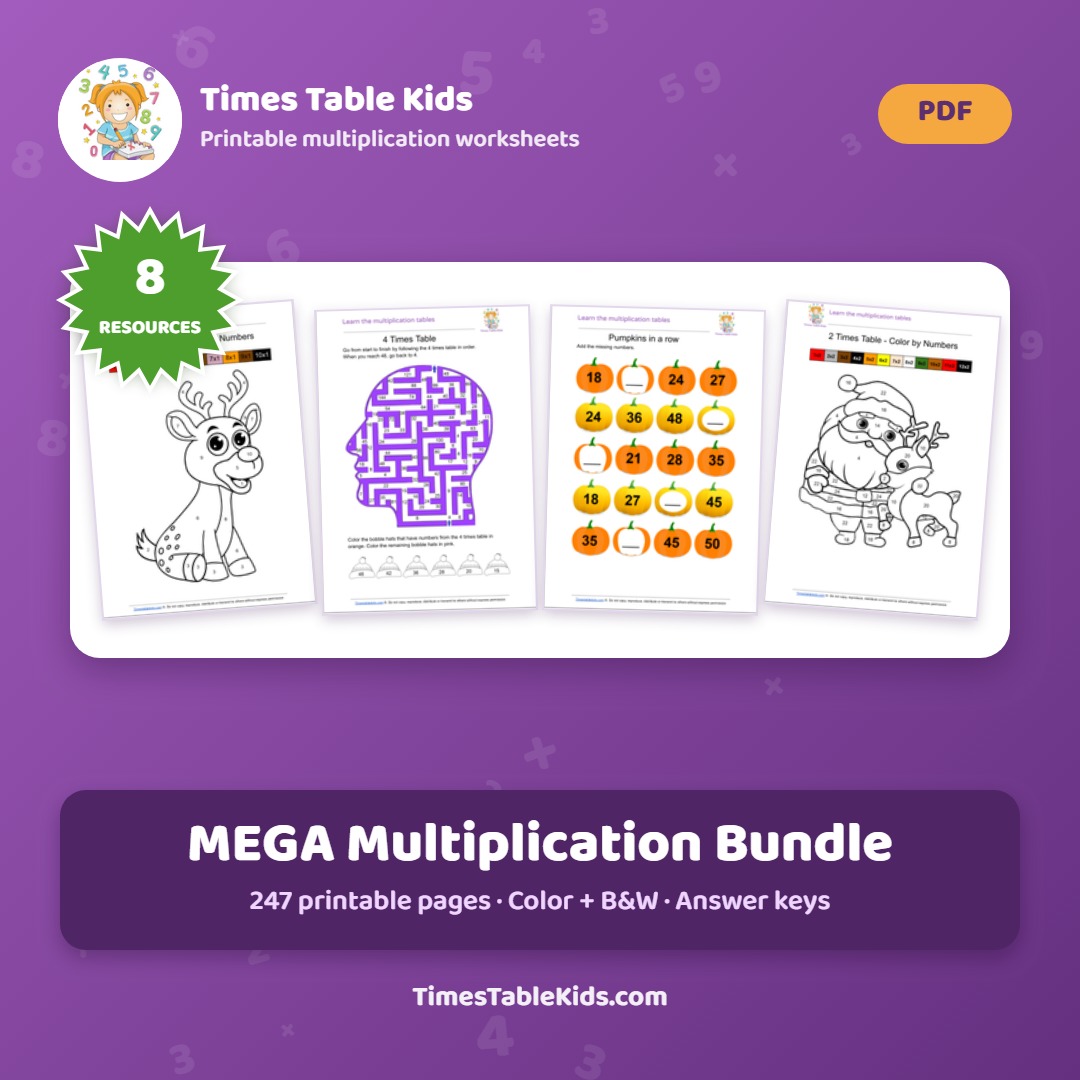
There is no MTC printable pack on this site. For centres, cover and homework that is not a generated sheet, the MEGA Multiplication Bundle is 247 pages, $12, one teacher licence. The mazes and colour-by-number in it cover 1–12, so you can pull the 6–9 and 12 pages for the weighted tables.
What to say to parents
Keep it short. The check has a reputation that is bigger than the six minutes it takes.
You can copy this:
Year 4 will sit the Multiplication Tables Check in school in June 2027. It is 25 questions, six seconds each, on a computer. There is no pass mark and it is not a SATs paper.
We will practise a little each week at school. At home, five minutes on one table is enough. This free practice page is the same format as the check, with no account and no app: https://timestablekids.com/multiplication-table-games/multiplication-table-check/
If the timer feels sharp at first, ignore it and just answer the questions. The real check is months away.
Link the official STA parent information when you send the letter, and say the date on our page is the 2027 window: MTC information for parents.
What not to do
- Do not run the simulator on day one of term. Baseline grid first, then this. The first-week routine is written for that.
- Do not tell the class there is a score they must beat. STA does not set one.
- Do not practise only 2, 5 and 10 until Easter. Those are the tables the check asks least.
- Do not send home a full 12×12 every night. One table, or the missed-tables sheet the simulator offers.
The simulator, the generator and the table pages are all free and need no account. That is deliberate: it has to work on a shared classroom machine, and you should not have to ask parents to sign children up to anything.